The post K9 Finance Offers Bounty for Return of Funds After Shibarium Exploit first appeared on The Shib Daily.
]]> Listen to This Article
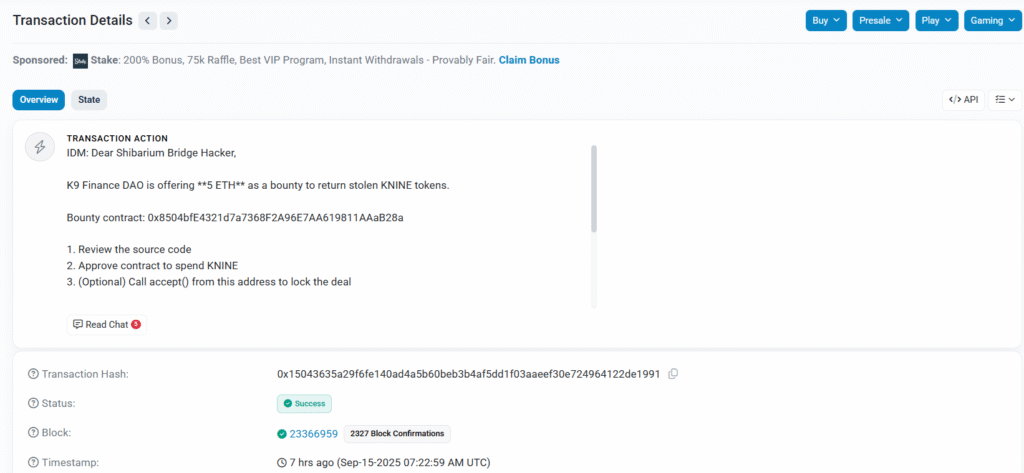
K9 Finance DAO has publicly offered a 5 Ether bounty to the perpetrator of a Friday exploit, delivering the proposal directly to the attacker’s wallet via an onchain message. The offer was made only after the project first froze approximately $700,000 in stolen $KNINE tokens, a strategic move that renders the assets untradeable and presents the bounty as the only way for the attacker to profit.
Key Points
- K9 Finance DAO froze $700,000 in stolen KNINE tokens and then offered the attacker a 5 Ether bounty via a public onchain message sent to their wallet.
- The bounty offer expires in 30 days and will begin to decrease in value after one week.
- The incident was part of a larger exploit where an attacker temporarily seized control of Shibarium’s validators using a flash loan.
The move followed a broader attack on Friday where a significant amount of digital assets were drained from the Shibarium bridge. According to Shiba Inu lead developer Kaal Dhairya, the event was a “sophisticated (probably planned for months) attack” carried out with a flash loan that allowed the attacker to gain majority control of the bridge’s validators and authorize a malicious transfer.
A Tactical Response
While the broader Shiba Inu development team responded to the breach by pausing network functions and contacting authorities, K9 Finance took a more targeted approach to its specific losses. The project’s developers first used an emergency function to blacklist the attacker’s wallet, immobilizing the stolen KNINE.
Only after securing the assets did the team extend the bounty offer on the blockchain. Buzz, the K9 Finance DAO’s pseudonymous lead developer, confirmed the strategy in a public statement. “They will never be able to sell or move these tokens,” he wrote. “Their only way of getting value is accepting the bounty.”
The offer was deployed via a trustless smart contract that remains active for 30 days and will see its reward decrease after one week.
Details of the Exploit and Response
The attacker initiated the exploit by using a flash loan to acquire 4.6 million BONE tokens. This temporarily gave them enough delegated power to achieve a majority among the bridge’s validators, allowing them to sign and approve a malicious transaction that transferred assets to their own wallet.
In a statement on X, Dhairya confirmed the technical details of the attack and the team’s immediate response, which included moving funds to a secure hardware wallet. While pursuing a formal investigation, he also signaled an openness to negotiate.
— Kaal (@kaaldhairya) September 13, 2025
Shibarium Bridge Security Update
Earlier today, a sophisticated ( probably planned for months ) attack was carried out using a flash loan to purchase 4.6M BONE. The attacker gained access to validator signing keys, achieved majority validator power, and signed a malicious…
“If the funds are returned, we will not press any charges and are willing to consider a small bounty,” he wrote.
 Follow on X
 Follow on Instagram


Read More
- Memecoins Are Not Dead: Why 2026 Marks the Biggest Comeback in Crypto History
- OpenAI Shuts Down Viral AI Video App Sora After Just Six Months
- Author Mia Ballard Denies AI Claims After Publisher Pulls ‘Shy Girl’
- Sen. Elizabeth Warren Slams Pentagon Over xAI Grok Classified Access
- French Couple Robbed of $1M in Bitcoin During Fake Police Raid
The post K9 Finance Offers Bounty for Return of Funds After Shibarium Exploit first appeared on The Shib Daily.
]]>The post DMs, Discords, and Deception: The Social Life of Crypto Phishing Attacks first appeared on The Shib Daily.
]]>- Phishing attacks have evolved beyond emails – Scammers now target trusted crypto spaces like Discord, Telegram, Twitter, and DMs, blending in with the community to exploit trust and FOMO.
- Human psychology is the main weapon – Impersonation, urgency, and herd behavior make users more likely to fall for scams, even if they understand technical security.
- Common social phishing tactics to watch – Fake DMs promising free tokens or NFT drops, impersonating bots or verified accounts, and malicious smart contract approval requests are all traps to avoid.
- Prevention is a mix of habits and awareness – Verify accounts and links, avoid suspicious transactions, stay vigilant in your community, and slow down before acting to outsmart phishing attacks.
Listen to This Article
You’re scrolling through Discord, excited about the latest NFT drop, when a DM pops up. It’s from someone claiming to be the project’s founder, offering you a “free mint” if you just click a link. It looks legit, the timing feels perfect, and before you know it, your wallet is at risk. Welcome to the wild world of phishing attacks, and yes, even in communities you trust, scammers are lurking.
Phishing has come a long way from sketchy emails with bad grammar. Today, attackers have learned to blend in with the groups, chats, and channels you spend your time in. They exploit trust, curiosity, and the fear of missing out to trick even experienced users.
The Evolution of Phishing in Crypto
Phishing attacks have come a long way since the days of poorly written emails promising you a million dollars if you just sent your password. In the crypto world, scammers have leveled up, moving into the very communities where you feel safest. Now it’s not just emails; it’s Twitter DMs from fake influencers, Telegram groups with bots pretending to be mods, and Discord servers that look official but are anything but.
Traditional warnings like “don’t click suspicious links” or “verify the sender” are no longer enough. These attacks are slick, blending in with real conversations, mimicking official handles, and even using project-specific jargon that newbies and veterans alike recognize. The more familiar the environment, the easier it is to let your guard down.
How Social Dynamics Make Phishing Effective
Phishing attacks aren’t just about clever links or fake websites. Scammers also play the human game, exploiting how we think, trust, and react in social settings. Understanding these social dynamics is key to staying safe in crypto communities.
Trust and Authority: Impersonation Tricks
Many phishing attacks succeed because we trust authority figures. Scammers impersonate founders, moderators, or influencers, making their messages seem official. That “friendly DM from the project team” can look 100% legitimate, and suddenly clicking a suspicious link feels normal.
FOMO and Urgency: The “Act Fast” Trap
Crypto culture thrives on urgency and exclusivity, and scammers use that against you. Fake “airdrops” or time-limited offers make users rush into actions like approving transactions or connecting wallets. A little pause and a double-check can save a lot of headache.
Herd Mentality: Following the Crowd
Humans naturally follow what others are doing, and scammers exploit this. Seeing a flood of users talking about free tokens or a hot NFT drop can make it tempting to jump in. The more people appear involved, the easier phishing attacks succeed.
By recognizing how trust, FOMO, and social pressure work together, even beginners can spot the tricks and make smarter decisions in crypto communities.
Common Social Phishing Tactics in Crypto
Phishing attacks in crypto are getting more creative, hiding in places where you feel safe, like DMs, Discord servers, and social media. Recognizing the tricks is key to staying safe.
Fake DMs Promising Free Tokens or NFT Airdrops
Scammers often slide into your DMs with offers that seem too good to be true. They promise free tokens or exclusive NFT airdrops if you click a link or connect your wallet. Watch out for:
- Messages from accounts claiming official status but aren’t verified
- Promises of “instant” rewards or limited-time offers
- Links that redirect to unfamiliar websites
Discord Bot Impersonation and Malicious Server Links
Discord servers are a favorite hunting ground. Bots or fake accounts can impersonate moderators or project teams, sending links to steal your crypto. Red flags include:
- Unexpected DMs or links from server bots
- Messages urging you to download software or visit unverified sites
- Requests to verify wallets in unusual channels
Fake “Verified” Accounts on X and Telegram
Scammers clone well-known accounts to gain your trust. They may post fake giveaways or urgent instructions to get you to act fast. Things to watch for:
- Slightly altered usernames or profile handles
- Urgent messages pushing you to click links immediately
- Claims that everyone else is “already participating”
Approval Scams: Malicious Smart Contract Requests
Even experienced users can fall for this sneaky trick. Scammers get you to approve transactions on a smart contract that looks harmless. After approval, they can move your tokens. Key warning signs:
- Requests to approve unlimited or unusually large token amounts
- Contracts that are new or unverified
- Offers that seem too simple or reward-heavy
By keeping an eye out for these patterns, you can spot phishing attacks before they hit and keep your crypto safe.
How Users Can Protect Themselves
Phishing attacks can be tricky, but most of them can be avoided with a mix of smart habits, community awareness, and a little healthy skepticism. Here’s how to keep your crypto safe without turning every click into a stress test.
Verify Accounts and Links Before Interacting
Not everyone claiming to be official is who they say they are. Take a moment to confirm identities before engaging. Tips include:
- Check profile handles carefully for subtle changes
- Hover over links to see the real URL before clicking
- Use official project channels to confirm announcements or DMs
Avoid Signing Suspicious Transactions or Connecting Wallets to Unknown dApps
Every approval you give can be risky. Only interact with platforms you trust:
- Never approve transactions from unknown contracts
- Avoid connecting your wallet to unverified dApps
- Double-check every request, even if it seems legitimate
Community Vigilance
Crypto safety is a team sport. Communities play a huge role in stopping phishing attacks:
- Report suspicious accounts or links to moderators
- Educate peers by sharing tips and red flags
- Utilize moderation tools to block bots and malicious activity
Mental Strategies: Slow Down and Question Urgency
Scammers thrive on speed and pressure. Slowing down helps you think clearly:
- Pause before clicking or signing anything
- Question offers that feel too good to be true
- Double-check instructions, links, and requests, even from familiar sources
By combining verification, caution, community awareness, and mindfulness, you can greatly reduce your risk and enjoy crypto without constantly looking over your shoulder.
Staying One Step Ahead
Phishing attacks are evolving, and as crypto grows, social spaces like Discord, Telegram, and Twitter can be just as risky as technical vulnerabilities in wallets or smart contracts. Scammers know how to blend in, play on trust, and exploit human behavior to get what they want.
The key takeaway? Stay alert, verify accounts and links, and don’t let FOMO push you into hasty decisions. Every user has a role to play in keeping the community safe. By reporting suspicious activity, educating peers, and thinking before you click, you can help build a stronger, smarter crypto ecosystem.
At the heart of it, understanding human behavior is your ultimate defense. Phishing attacks may never disappear entirely, but recognizing the psychology behind them gives you the power to avoid the traps and enjoy the world of crypto safely.
Read More
- Crypto Scam: Fake Law Firms Target Victims, What SHIB Holders Should Know
- Crypto User Loses $908K in Sneaky Phishing Scam — What It Means for SHIB Holders
- How to DYOR and Avoid Crypto Scams Like a True Shib Army Pro
Michaela has no crypto positions and does not hold any crypto assets. This article is provided for informational purposes only and should not be construed as financial advice. The Shib Magazine and The Shib Daily are the official media and publications of the Shiba Inu cryptocurrency project. Readers are encouraged to conduct their own research and consult with a qualified financial adviser before making any investment decisions.
The post DMs, Discords, and Deception: The Social Life of Crypto Phishing Attacks first appeared on The Shib Daily.
]]>The post ‘Coinbase Hacker’ Spends $8M on Solana — SHIB Holders Take Note first appeared on The Shib Daily.
]]>The Coinbase Hacker recently spent nearly $8 million buying Solana, after previously selling large amounts of Ether. This shows that stolen crypto can still move even when wallets are publicly tracked. Blockchain transparency allows monitoring, but it doesn’t prevent the transfer of funds once they reach exchanges or platforms.
A crypto wallet linked to the so-called “Coinbase Hacker,” accused of stealing over $300 million from Coinbase users, has reportedly purchased nearly $8 million worth of Solana (SOL).
Blockchain analytics platform Lookonchain reported that the hacker converted DAI to USDC, bridged the funds to the Solana network, and acquired 38,126 SOL through multiple transactions.
The wallet linked to the alleged “Coinbase Hacker” first drew attention in June when it sold 26,762 Ethereum (ETH), valued at $69.25 million at the time. Lookonchain reported that in July, the same wallet made two significant purchases, including 649 ETH for $2.3 million at an average price of $3,562 per token.
The recent activity by the Coinbase Hacker has sparked considerable attention online, with observers questioning how the wallet can continue trading under scrutiny and which exchanges may be processing the transactions.
The Coinbase Hacker’s recent trades emphasize the challenges of tracking stolen crypto even when wallets are publicly labeled and under surveillance. Analysts note that while blockchain transparency allows anyone to monitor transactions, it does not automatically prevent the movement of funds once they enter exchanges or decentralized platforms.
Coinbase Hacker Spurs SHIB Security Focus
The recent Coinbase Hacker activity spotlights the importance of strong security practices for all crypto investors. For SHIB holders, it emphasizes why relying solely on exchanges can leave assets vulnerable to theft or exploitation.
Using personal wallets provides greater control over private keys and reduces the risk of losing funds in the event of an exchange breach. Beyond wallet security, enabling multi-factor authentication adds an extra layer of protection, making it significantly harder for unauthorized actors to access accounts.
Staying informed about market activity and blockchain developments is equally critical, as it allows investors to spot unusual transactions or potential threats early. Regularly updating software, using unique and strong passwords, and considering hardware wallets for larger holdings are practical steps to mitigate risk.
While hacks and exploits can affect the broader cryptocurrency ecosystem, adopting these proactive security measures empowers SHIB investors to safeguard their tokens and navigate the market with greater confidence. Vigilance and education remain key tools in maintaining asset security in a rapidly evolving digital landscape.
Read More
- Coinbase and Indian Minister Explore Blockchain Push — What It Means for SHIB
- Coinbase Battles Domain Squatter — What SHIB Holders Need to Know
- Supreme Court Lets IRS Keep Access to Coinbase User Crypto Data
Michaela has no crypto positions and does not hold any crypto assets. This article is provided for informational purposes only and should not be construed as financial advice. The Shib Magazine and The Shib Daily are the official media and publications of the Shiba Inu cryptocurrency project. Readers are encouraged to conduct their own research and consult with a qualified financial adviser before making any investment decisions.
The post ‘Coinbase Hacker’ Spends $8M on Solana — SHIB Holders Take Note first appeared on The Shib Daily.
]]>The post Shiba Inu Reveals LEASH v2 Token Design: Simple, Secure, Auditable first appeared on The Shib Daily.
]]>- Migrator Cannot Mint: LEASH v2 tokens are pre-minted; the migration contract only transfers existing tokens.
- Audit-Ready Architecture: The token and migrator use standard, widely-audited libraries to ensure transparency and prevent manipulation.
- Community Governance: Unclaimed tokens and final migration rules will be decided by the DAO, giving holders direct oversight.
Shiba Inu’s lead developer has unveiled the technical blueprint for the long-awaited LEASH v2 token—a redesign that strips complexity back to its core, eliminates minting risks, and hands final supply control to the DAO, directly addressing the concerns that arose from the v1 token’s rebase mechanism.
A ‘No Mint’ Migrator
The cornerstone of the new system’s security is its migrator contract. To eliminate any possibility of unauthorized token creation, the contract will not have a minting function.
“The migrator will not have any power to mint tokens,” Dhairya explained. Instead, the entire supply of LEASH v2 will be pre-minted at deployment and held in a multisignature wallet.
When a holder migrates their v1 tokens, the system doesn’t create a new supply—it simply verifies the deposit and releases a pre-approved equivalent amount of v2 from the multisig. According to Dhairya, this design “removes any lingering doubt about supply manipulation,” since the contract can only move what already exists.
This minimal-trust architecture marks a direct response to community anxiety after the v1 rebase controversy, which left some investors wary of hidden mechanisms or token inflation.
Standard ERC-20, With Advanced Features Deferred
In another move toward simplicity, LEASH v2 itself will launch as a standard ERC-20 token, built using OpenZeppelin’s widely audited libraries.
While the team considered launching with more advanced capabilities—such as Fully Homomorphic Encryption (FHE) for privacy-preserving transactions—Dhairya confirmed the decision to hold back.
“The plan is to keep the base token simple now and wrap it later under the confidential-token standard,” he wrote. This phased approach prioritizes stability and security first, with innovation deferred to secondary layers once confidence is restored.
Importantly, both the token and the migration contract will undergo a full, independent audit, ensuring no hidden functions or supply loopholes remain.
DAO to Decide Final Supply Fate
Once migration concludes, any unclaimed v2 tokens left in the multisig wallet won’t sit idle. Instead, Dhairya proposed they could be burned permanently—but not without community approval.
“The DAO will decide,” he affirmed, underscoring that ultimate control rests with Shiba Inu’s decentralized governance system. The community may also vote on whether to set a hard cutoff date for migration or keep the process open-ended.
This gives token holders a direct hand in shaping LEASH v2’s economic future, reinforcing the principle of DAO-controlled supply integrity.
LEASH v1’s unexpected rebases left many holders uncertain about supply and fairness. With v2, Shiba Inu has removed minting powers, simplified the token’s design, and ensured that any leftover supply will be governed by the DAO. The changes aim to make the system predictable, verifiable, and fully under community control.
In Dhairya’s words: “The system—from token to migrator—is engineered so anyone can verify its fairness. Nothing hidden, nothing left to doubt.”
Read More
- Shiba Inu Developer Unveils New LEASH v2 Migration Strategy
- Shiba Inu Bullish Divergence Signals Possible 155% Price Explosion
- K9 Finance DAO’s Bonecrusher v3 Now Brings New Pools to Shibarium
The post Shiba Inu Reveals LEASH v2 Token Design: Simple, Secure, Auditable first appeared on The Shib Daily.
]]>The post The Digital Family Safe: How Multi-Sig Wallets Protect Shared Crypto first appeared on The Shib Daily.
]]>- Shared Security and Control: Multi-sig wallets allow multiple family members to approve transactions, reducing risks from lost keys, theft, or accidental spending.
- Collaborative Financial Goals: Families can use multi-sig wallets for emergency funds, vacations, education savings, or pooled investments, turning digital finance into a team effort.
- Easy Setup and Management: With the right provider, clear approval rules, and secure key management, multi-sig wallets are accessible and practical for families, even for beginners.
- Building Trust and Responsibility: Using multi-sig wallets teaches transparency, accountability, and shared financial responsibility, making crypto management both secure and educational for the whole family.
Picture this: your neighbors are planning a dream family vacation. Everyone chips in for the flights, hotels, and activities, but instead of stuffing cash under the mattress, they’re pooling their crypto. Enter multi-sig wallets, a kind of digital family safe where multiple approvals are needed before any funds can be spent. Suddenly, managing money together becomes safer and a lot more fun.
Crypto isn’t just for tech geeks or Wall Street types anymore, it’s slowly weaving its way into everyday family life, from allowances to shared savings goals. And just like you wouldn’t leave a suitcase of cash lying around at home, digital assets need proper protection. That’s why securing crypto is becoming just as important as safeguarding traditional money, and why families are turning to tools like multi-sig wallets to keep their shared goals on track.
What Are Multi-Sig Wallets?
So, what exactly are multi-sig wallets? Think of them as a digital safe for your family’s crypto. Instead of one person holding the keys and calling all the shots, multi-sig wallets require multiple approvals before any funds can be moved. For example, if your family sets it up so that three out of four members must approve a transaction, nobody can sneak off with the money or make a costly mistake on their own.
It’s a lot like a joint bank account, but with extra layers of security and control. Everyone has a say, and every move is logged on the blockchain for transparency. Unlike regular crypto wallets, where a single private key gives total access, multi-sig wallets split control across multiple people. That way, even if one key is lost or compromised, the funds are still safe, making it perfect for families who want to save, spend, and learn together.
Why Families Need a Digital Safe
Managing crypto as a family can feel exciting, but it also comes with risks. That’s where multi-sig wallets step in, a way to keep funds safe while giving everyone a say in how they’re used.
The Risks of Single-Key Wallets
Putting all your crypto in a wallet controlled by one person sounds simple, but it comes with real risks:
- Losing the private key or password
- Accidental mistakes like sending funds to the wrong address
- Theft or hacking of a single key
The Benefits of Shared Control
Multi-sig wallets turn those risks into opportunities for teamwork:
- Accountability: Every transaction needs approval from multiple family members
- Transparency: Everyone can see what’s happening in the wallet
- Trust: No single person can move funds alone
Family Goals Made Easier
Multi-sig wallets aren’t just for security, they help families reach shared goals:
- Emergency funds for unexpected bills
- Saving for vacations or big trips
- Pooling crypto for shared investments
- Education savings or allowances for kids
With multi-sig wallets, families can manage digital assets safely while learning collaboration, planning, and financial responsibility together.
Setting Up a Family Multi-Sig Wallet
Ready to create your own digital family safe? Multi-sig wallets make it easier than you might think, and you don’t need to be a tech wizard to get started. Here’s a high-level guide to setting one up for your family.
Step 1: Choose a Wallet Provider
Pick a reputable provider that supports multi-sig wallets. Look for:
- Strong security and encryption
- User-friendly interfaces
- Good customer support or tutorials
Step 2: Decide on the Approval Rules
This is where you set how many family members need to approve a transaction before funds can move. Examples:
- 2 of 3 family members must approve
- 3 of 4 for larger families or more security
- Keep it simple but flexible so everyone can participate
Step 3: Add Family Members
Each member gets a “key” to the wallet. Make sure they understand their role and the importance of keeping their keys secure.
Step 4: Tips for Secure Key Management
Even with multi-sig wallets, security is crucial. Some best practices:
- Use strong, unique passwords for wallet accounts
- Store backup keys offline in a safe location
- Avoid sharing keys over unsecured channels
- Review wallet activity regularly
With these steps, your family can safely pool and manage crypto while learning collaboration and responsibility. Multi-sig wallets turn digital finance into a shared adventure instead of a solo risk.
Real-Life Use Cases
Multi-sig wallets aren’t just a fancy tech tool, they actually make everyday family life easier and more secure. Let’s look at some ways families are putting them to work.
Vacation Fund
Planning a big trip? With a multi-sig wallet, you can set it so that 3 of 4 family members must approve any spending. This keeps the savings safe and makes sure everyone has a say in how the money is used. No more accidental overspending on souvenirs or surprise splurges.
Emergency Savings
Life is unpredictable. Multi-sig wallets allow families to create a secure emergency fund that multiple members control. If an unexpected bill pops up, funds can only be accessed with the agreed approvals, giving peace of mind that the money won’t be used frivolously.
Collecting Crypto Gifts or Donations
Birthdays, holidays, or charitable giving, families can pool crypto gifts or donations in a shared wallet. Multi-sig approvals ensure everyone involved agrees on how to spend or distribute the funds. It’s a safe and transparent way to manage collective contributions.
By using multi-sig wallets in these everyday scenarios, families can turn digital finance into a collaborative experience, combining security, transparency, and fun while achieving shared goals.
The Digital Family Safe Mindset
Multi-sig wallets show that managing crypto doesn’t have to be scary or complicated. By sharing control, families can enjoy peace of mind knowing their funds are secure, every decision is transparent, and trust is built into the system. It turns digital finance from a solo risk into a team effort where everyone participates.
Think of it as more than just a tool, it’s a mindset. Treat your crypto like a digital family safe where collaboration, planning, and responsibility go hand in hand. Whether it’s saving for a vacation, an emergency fund, or collecting crypto gifts, multi-sig wallets give families a practical, forward-looking way to manage money together.
The future of family finance is already here, and it’s secure, shared, and smart. Multi-sig wallets make it easy to step into that future with confidence and a little fun along the way.
Read More
- Dividing Crypto in Divorce: Who Gets the Wallet, Keys, and NFTs?
- Crypto Custody Battles: Who Really Owns a Child’s Digital Fortune?
- Family Crypto Savings: How to Move from Piggy Banks to Digital Wallets
Michaela has no crypto positions and does not hold any crypto assets. This article is provided for informational purposes only and should not be construed as financial advice. The Shib Magazine and The Shib Daily are the official media and publications of the Shiba Inu cryptocurrency project. Readers are encouraged to conduct their own research and consult with a qualified financial adviser before making any investment decisions.
The post The Digital Family Safe: How Multi-Sig Wallets Protect Shared Crypto first appeared on The Shib Daily.
]]>The post What Is a Rug Pull and How Do You Spot One Before It’s Too Late first appeared on The Shib Daily.
]]>Key points:
- A rug pull is when crypto project creators suddenly disappear with investor funds, often after hyping a token, NFT, or DeFi app. It leaves buyers with worthless assets and no recourse.
- Common red flags include anonymous or unverifiable devs, unrealistic promises, unlocked liquidity, shady smart contract behavior, and low-quality social engagement.
- Before investing, check liquidity lock status, research the team, review tokenomics, monitor holder distribution, and look for audit reports or contract scans.
- If you suspect a rug pull, exit quickly if possible, warn the community, report the project, and keep up with scam alerts to protect yourself in the future.
Listen to This Article
Crypto can feel like a wild west, full of opportunity but also plenty of traps. One of the sneakiest tricks in this world is the “rug pull.” Imagine stepping onto a fancy rug, only to have it yanked out from under you. That’s exactly what happens when a project’s creators suddenly vanish with all the money, leaving investors holding nothing but worthless tokens.
Rug pulls are a major headache in crypto and decentralized finance (DeFi) because they can wipe out your investment in seconds. Since many projects launch with little regulation or oversight, these scams have unfortunately become all too common.
That’s why learning how to spot warning signs early is key. The sooner you recognize the red flags, the better your chances of keeping your funds safe and enjoying the exciting possibilities crypto has to offer. Think of this as your beginner’s survival guide to the crypto jungle, because knowing what to watch for can make all the difference.
What Exactly Is a Rug Pull?
So let’s break it down, what is a rug pull, really? In crypto lingo, it’s when the creators of a project suddenly drain the funds and disappear, usually after hyping up a token, NFT collection, or DeFi platform to attract investors. You trust the project, invest your money, and then, poof, the developers vanish and your funds are gone. It’s the crypto version of being ghosted… but with your wallet involved.
These shady stunts usually happen in three common settings:
1. DeFi Liquidity Pools – This is a big one. In DeFi, projects often rely on liquidity pools, basically, pots of money that let people trade tokens smoothly. But if the devs control the pool and decide to yank all the funds, it’s game over. That’s a rug pull.
2. NFT Projects – Remember when everyone and their dog was launching NFT collections? Some of those projects promised roadmaps, metaverses, and private islands… then disappeared once they cashed in on the hype. That’s another classic rug moment.
3. Meme Tokens & Hype Coins – New token drops with names like “FluffyDogeRocket” often go viral fast. But if the team holds most of the tokens and sells off when prices spike, early buyers are left with digital dust. And yep, you guessed it, that’s a rug pull too.
The fallout? Besides investors losing money (and trust), rug pulls erode confidence in the crypto space as a whole. They make it harder for legit projects to thrive and give critics more fuel to call crypto a scammy playground. But don’t worry, we’re here to help you spot the rugs before they fly out from under you.
How Rug Pulls Work: The Mechanics
So, how do these crypto con artists actually pull the rug? It’s not magic, it’s code, timing, and a lot of marketing hype. The typical rug pull starts with a project that looks exciting and fresh. There’s usually a shiny website, slick branding, maybe even a Telegram group full of GIFs and moon emojis. Everything screams “next big thing.” But behind the scenes, the developers are setting the trap.
Here’s a peek behind the curtain:
Step 1: Hype the Project
The team launches a new token or DeFi app, builds some buzz on X, Discord, or Reddit, and often drops phrases like “1000x potential” or “liquidity locked for your safety.” Early investors rush in, FOMO kicks in, and prices start to rise.
Step 2: Control the Pool
In many rug pull cases, the team controls the liquidity pool, meaning they can pull the plug whenever they want. That pool is where buyers and sellers trade tokens, and if the devs remove the liquidity, everyone else is left holding bags they can’t sell.
Step 3: The Vanish
Once the price pumps and the team decides they’ve squeezed enough out of the hype, they drain the pool or dump their tokens on the market. Prices crash. Websites go offline. Discords get deleted. The devs are gone, and so is your investment.
A few famous rug pulls to remember:
- Squid Game Token (SQUID) — Launched after the Netflix series blew up. It skyrocketed in price, then the devs cashed out and vanished. Investors couldn’t even sell the token.
- Meerkat Finance — A DeFi project that disappeared with over $30 million in user funds within 24 hours of launch.
- Frosties NFT — Promised long-term benefits and a cool community but the founders disappeared shortly after launch. Later, they were charged with fraud.
The key takeaway? Just because something’s trending or slick-looking doesn’t mean it’s safe. Rug pulls rely on speed, hype, and lack of scrutiny. But you can learn to see them coming.
Key Warning Signs and Red Flags
Spotting a rug pull before it happens isn’t about having a crystal ball. It’s about knowing what to look for. Scammers often follow patterns, and if you know the signs, you can dodge the worst of them. Here are the biggest red flags to watch out for when checking out a new crypto project:
1. Mystery Devs
If you can’t figure out who’s behind a project, that’s a problem. Anonymous teams aren’t always bad, some legendary projects started that way, but if there’s zero verifiable history, no public presence, and every team member has the same AI-generated profile pic, it’s worth a pause.
2. Wild Promises
“Guaranteed 100x in a week.” “Risk-free passive income forever.” Sound familiar? If the pitch feels more like a lottery ad than a real business, run. No project can promise massive returns without risk.
3. Locked vs. Unlocked Liquidity
This one’s a bit technical, but important. When a project locks its liquidity, it means the devs can’t suddenly yank the funds out. If the liquidity is unlocked, they can remove it at any time, which is exactly how many rug pulls go down. Always check if liquidity is locked, and for how long.
4. Smart Contract Shenanigans
Smart contracts are the code that runs crypto projects. If the code is constantly changing or hasn’t been audited by a trusted third party, that’s a red flag. Some scammers hide sneaky functions that let them drain funds, block users from selling, or mint unlimited tokens.
5. Suspicious Socials
Is the project’s X account full of bots and giveaways but no real conversation? Is the Discord all hype and no substance? Low community engagement or copy-paste replies can mean the team’s more focused on pumping the token than building a product.
6. Radio Silence When You Ask Questions
Good projects welcome questions and feedback. Scammy ones either ignore them, delete comments, or ban you for asking. If transparency disappears the moment you speak up, that says a lot.
The good news? Once you know these warning signs, you start spotting them everywhere. Staying curious and asking the right questions is one of the best ways to protect yourself in the wild world of Web3.
What to Do If You Suspect a Rug Pull
You’re in a project, things are feeling weird, and your gut’s screaming something isn’t right. Maybe the devs have gone silent, maybe the token price is tanking, or maybe you just spotted a big red flag. If you think a rug pull might be brewing, don’t panic, but don’t freeze either.
- Move Fast, Exit Smart – The first thing to do is get out if you still can. If the token is tradable and liquidity is still there, consider selling before it vanishes. Even if you take a small loss, it’s better than watching your balance hit zero. But don’t rush so fast you fumble your transaction, slippage settings and gas fees still apply.
- Warn the Herd – Let others know. Post a heads-up in the project’s Telegram, Discord, or subreddit. If it’s truly shady, other users might be spotting the same signs. Public pressure sometimes spooks devs into coming clean, or at least stalls them. If the project is listed on platforms like CoinGecko or CoinMarketCap, you can also submit scam reports.
- Report It Where It Counts – Platforms like Etherscan, BscScan, or RugDoc often have places to flag suspicious tokens. You can also report known scams to communities on Reddit, or even to regulators if real money was lost. The more visibility a scam gets, the harder it is for the same people to try again under a new name.
- Keep Learning, Stay Sharp – Crypto changes fast, and so do the tactics scammers use. Follow trusted voices on X, join reputable communities, and bookmark sites that track active scams. Staying in the loop means you’re way less likely to be blindsided next time.
Even the smartest investors get caught now and then. What matters is learning from the close calls and building your radar. You don’t need to be paranoid, just prepared.
At the end of the day, avoiding a rug pull isn’t about luck, it’s about staying sharp, asking questions, and not getting swept up in hype without doing your homework. The crypto space is full of innovation and opportunity, but it’s also full of smoke and mirrors if you don’t know where to look.
That’s where your new checklist comes in. Whether it’s checking liquidity locks, scanning smart contracts, or just doing a quick background check on the team, these small steps can make a big difference. Keep it handy whenever you’re considering a new token or project, and trust your instincts if something feels off.
Crypto doesn’t have to be a gamble. With the right tools and a healthy dose of curiosity, you can enjoy the ride, spot the scams, and actually grow your investments. Staying informed is your best defense, and now you’ve got the knowledge to walk through Web3 with confidence.
Read More
- Crypto Rug Pulls Targeted in NY Lawmakers’ Proposed Crackdown Bill
- Influencer-Backed HAWK Token Faces Lawsuit Following Rug Pull Accusations
- From Screen to Scheme: Squid Game Crypto Scam Hits Close to Home
Michaela has no crypto positions and does not hold any crypto assets. This article is provided for informational purposes only and should not be construed as financial advice. The Shib Magazine and The Shib Daily are the official media and publications of the Shiba Inu cryptocurrency project. Readers are encouraged to conduct their own research and consult with a qualified financial adviser before making any investment decisions.
The post What Is a Rug Pull and How Do You Spot One Before It’s Too Late first appeared on The Shib Daily.
]]>The post Foreign Gang Arrested in Phuket Crypto Robbery Worth $250K first appeared on The Shib Daily.
]]>Thai authorities arrested four foreign nationals in connection with a Phuket crypto robbery, allegedly forcing a Ukrainian tourist to transfer $250,000 in cryptocurrency after luring him to a meeting.
Phuket’s Kamala Police, with support from Tourist Police, apprehended the suspects — Armenian national Arman, 21; Ukrainian nationals Alfred, 18, and Ruslan, 22; and Russian national Mraz, 21 — at a hotel in Phang Nga Province on November 11. The arrests followed a warrant issued by the Phuket Provincial Court for armed robbery, unlawful detention, and coercion.
The incident reportedly took place on November 8 when the victim, a 23-year-old Ukrainian named Viacheslav, was invited by a friend, Alfred, to a room. Once inside, he was ambushed by two masked men who attacked him, put him in a chokehold, and restrained him with ropes and cable ties. The perpetrators allegedly threatened to break his fingers unless he transferred $500,000 in cryptocurrency. Following negotiations, they lowered their demand to $250,000.
After the transfer, the suspects tied Viacheslav to a bed, warning him not to report the incident before fleeing with additional belongings from the room. Viacheslav later managed to escape, obtained photographic evidence from the hotel reception, and reported the incident to the police.
The suspects in the Phuket crypto robbery are now in custody at the Kamala Police Station, where they face multiple charges, including armed robbery, unlawful detention, and coercion. Thai authorities continue their investigation, with officials emphasizing their commitment to protecting tourists and ensuring that those involved in organized crime face strict penalties.
This case shares a troubling pattern with a similar incident involving a Toronto-based cryptocurrency CEO. Dean Skurka, CEO of WonderFi Technologies, endured a kidnapping ordeal in Toronto, where he was reportedly abducted during rush hour and held for a $1 million ransom. Toronto police reported that suspects forced Skurka into a vehicle, later releasing him unharmed after the ransom was paid.
This incident, alongside the Phuket robbery, highlights the growing security threats faced by high-profile individuals in the crypto industry, where significant wealth in digital assets can make them targets for organized criminal activity.
Read More
- Thai Police Allegedly Hold Chinese Businessman Hostage for $10 Million Crypto Ransom
- North Korean Hackers Target Crypto Firms with Hidden Risk Malware
- Ex-FTX Executive Escapes Jail Time, but Not the Weight of His Crimes
Vanessa has no crypto positions and does not hold any crypto assets. This article is provided for informational purposes only and should not be construed as financial advice. The Shib Daily is an official media and publication of the Shiba Inu cryptocurrency project. Readers are encouraged to conduct their own research and consult with a qualified financial adviser before making any investment decisions.
The post Foreign Gang Arrested in Phuket Crypto Robbery Worth $250K first appeared on The Shib Daily.
]]>The post North Korean Hackers Target Crypto Firms with Hidden Risk Malware first appeared on The Shib Daily.
]]>Cybersecurity firm SentinelLabs has identified a new malware campaign called Hidden Risk, launched by North Korean hackers BlueNoroff, targeting cryptocurrency businesses.
The campaign, first observed in October but possibly active since July, uses phishing emails with fabricated crypto news headlines to infiltrate organizations in the crypto industry, SentinelLabs said in a report released on Thursday.
Phishing emails contain links to PDFs on topics such as “Hidden Risk Behind New Surge of Bitcoin Price” and “Altcoin Season 2.0—The Hidden Gems to Watch,” aiming to lure victims into downloading malware.
North Korean hackers BlueNoroff reportedly impersonated real individuals from unrelated industries, forwarding messages purportedly from well-known crypto social media influencers. In one instance, the attackers replicated a legitimate research paper titled “Bitcoin ETF: Opportunities and Risks” by a University of Texas academic, originally hosted by the International Journal of Science and Research Archive (IJSRA).

Unlike previous operations by BlueNoroff, the Hidden Risk campaign uses simpler phishing emails without personal or context-specific details. The sender domain used, kalpadvisory[.]com, is associated with spam activity in Indian stock market forums, according to SentinelLabs.
“While North Korean cyber actors have previously engaged in extensive target grooming on social media, this campaign adopts a more direct phishing strategy,” said SentinelLabs.
Researchers suggest that increased scrutiny of North Korean cyber activities may have made social media tactics less effective due to heightened awareness among targets in sectors like decentralized finance (DeFi) and exchange-traded funds (ETFs). However, state-backed actors are likely to deploy multiple strategies concurrently.
The campaign demonstrates the hackers’ ability to obtain valid Apple “identified developer” accounts, achieve malware notarization by Apple, and bypass macOS security measures such as Gatekeeper, SentinelLabs noted. The firm urged macOS users, particularly within organizations, to enhance their security measures and remain vigilant to potential threats.
The findings come after the U.S. Federal Bureau of Investigation warned that North Korean hackers are using sophisticated social engineering campaigns against cryptocurrency operations.
Read More
- Former FTX Executives Sentenced: Gary Wang Seeks Leniency, Caroline Ellison Begins Prison Term
- Lazarus Group Levels Up with Fake Blockchain Game in Crypto Heist
- Hackers Briefly Borrow $20M in Crypto from US Gov, Returns it (Mostly) Intact
Vanessa has no crypto positions and does not hold any crypto assets. This article is provided for informational purposes only and should not be construed as financial advice. The Shib Daily is an official media and publication of the Shiba Inu cryptocurrency project. Readers are encouraged to conduct their own research and consult with a qualified financial adviser before making any investment decisions.
The post North Korean Hackers Target Crypto Firms with Hidden Risk Malware first appeared on The Shib Daily.
]]>The post SEC’s $400M Crypto Enforcement Push Sparks Demand for Clear Guidelines first appeared on The Shib Daily.
]]>The U.S. Securities and Exchange Commission (SEC) has spent over $400 million in litigation costs as part of its ongoing crypto crackdown, according to a recent report by the Blockchain Association.
Under the leadership of Chair Gary Gensler, known for his aggressive stance on cryptocurrency regulation, the SEC has intensified its efforts to impose stricter oversight on the digital asset market. Gensler’s commitment to safeguarding investors and establishing a regulatory framework for cryptocurrencies has sparked significant debate. It has consistently raised questions about the effectiveness and financial implications of such a costly endeavor in the crypto sector.
The report sourced data from intelligence platform HarrisX, which surveyed U.S. voters, business decision-makers, and cryptocurrency voters. It aimed to understand their views on the digital asset landscape and the SEC’s regulatory actions.
The report revealed that the SEC, under Gensler, has taken action against a record 104 entities in the digital asset sector. Voter preference shows a clear desire for defined rules over enforcement, with a two-to-one ratio. Consequently, this highlights the crypto community’s demand for clear SEC guidelines instead of vague enforcement practices.
The survey showed that no political party “owns” the crypto issue. However, voters are more inclined to back candidates that promote innovation in digital assets. Notably, crypto voters constitute 18% of the electorate and are more open to supporting candidates who oppose the undefined actions of the SEC.
Gensler’s Controversial Reign Faces Potential Legal Reckoning
Crypto analyst MartyParty holds the view that Gensler will face substantial legal challenges from the industry. He believes that numerous class action civil suits will likely follow his departure from office. He also argues that Gensler cannot evade the consequences of his “misuse of power.”
The Blockchain Association says the @SECGov has cost the crypto industry $400 million since Gary Gensler became chair.
— MartyParty (@martypartymusic) October 31, 2024
IMO: He will be sued heavily by industry and class action civil suits post office.
You don’t get away with this type of misuse of power.
Not a single…
Kristin Smith, CEO of Blockchain Association, offered her insights on the matter in a statement on X. “The SEC’s regulation-by-enforcement approach is harming the United States’ global tech leadership—and failing the American investor the SEC is mandated to protect,” she said. She emphasized that the organization remains committed to its mission. It will advocate for its members through legal means and public discussions, aiming to maximize the potential of crypto and blockchain in the U.S. “That begins with a change of leadership,” Smith added.
Paul Grewal, chief legal officer of Coinbase, chimed in to remind the crypto community that the SEC effectively sourced its more than $400 million funding for its anti-crypto crusade from them. He urged individuals to keep this in mind when they log their work hours, file their taxes, and, crucially, when they head to the polls.

Read More
- M2 Thwarts $13.7 Million Crypto Heist, Recovers Funds in Minutes
- The Rise of the Crypto Influencers: Are Whitepapers Losing Their Grip?
- ShibaSwap 2.0: Maximize Your Earnings
The post SEC’s $400M Crypto Enforcement Push Sparks Demand for Clear Guidelines first appeared on The Shib Daily.
]]>The post M2 Thwarts $13.7 Million Crypto Heist, Recovers Funds in Minutes first appeared on The Shib Daily.
]]>Dubai-based cryptocurrency platform M2 reported a cybersecurity breach early Thursday, which involved a $13.7 million loss but was quickly mitigated within 16 minutes of detection.
The incident occurred at 3:16 AM (GMT+4) and was addressed by the platform’s security team by 3:32 AM. In a statement, M2 confirmed that the situation has been fully resolved, customer funds restored, and enhanced security protocols implemented.
M2 assured users that it has taken full responsibility for the incident and is working with legal and regulatory authorities to ensure thorough follow-up on the matter.
“This incident underscores our commitment to protecting customer assets and maintaining a secure platform. We are dedicated to upholding the highest standards of security and compliance,” M2 stated, adding that all services are now operational with strengthened controls in place.
The breach at M2 comes nearly four months after a major attack on WazirX, the Indian cryptocurrency exchange, where hackers stole over $230 million, marking it the second-largest cryptocurrency theft of 2024. According to a Crystal Intelligence report, the crypto sector has faced substantial challenges with nearly $19 billion lost across 785 reported hacking incidents from 2010 to June 2024.
As cryptocurrency adoption grows, hacks and scams have emerged as significant barriers. In February 2024, PlayDapp was hit with the year’s largest security breach, losing $290 million, while the JPEX investment scam in Hong Kong saw $194.3 million in crypto vanish in the same period.
Analysts note that while decentralized finance (DeFi) platforms have suffered heavily in recent years, centralized exchanges remain the primary targets in terms of total value stolen. The USA led with 34 incidents totaling $984 million, followed by Hong Kong with 15 incidents at nearly $1.2 billion. South Korea saw 13 incidents worth over $380 million, the UK 12 incidents at $618 million, and Singapore 10 incidents totaling $134 million.

Source: Crystal Intelligence
As M2 and other exchanges reinforce cybersecurity, industry experts stress that stronger security measures and regulatory collaboration will be key to preventing further attacks and fostering greater trust in digital assets.
Read More
- Hackers Briefly Borrow $20M in Crypto from US Gov, Returns it (Mostly) Intact
- MrBeast Profited $23M From Questionable Crypto Schemes – Report
- Ex-FTX Executive Escapes Jail Time, but Not the Weight of His Crimes
Vanessa has no crypto positions and does not hold any crypto assets. This article is provided for informational purposes only and should not be construed as financial advice. The Shib Daily is an official media and publication of the Shiba Inu cryptocurrency project. Readers are encouraged to conduct their own research and consult with a qualified financial adviser before making any investment decisions
The post M2 Thwarts $13.7 Million Crypto Heist, Recovers Funds in Minutes first appeared on The Shib Daily.
]]>The post The Shib Crypto Recap: Wednesday first appeared on The Shib Daily.
]]>Bitcoin Bribe Exposed: Former Chief Investigator Sentenced to 16 Years
A former chief investigator in Russia, Marat Tambiyev, has been sentenced to 16 years in prison for accepting a Bitcoin bribe worth $65 million from hackers. His case is part of a major corruption scandal within the Investigative Committee of Russia. Investigations into Tambiyev began last year and uncovered his acceptance of bribes from the Infraud Organization. This issue highlights the ongoing corruption in Russian law enforcement agencies that struggle against cybercrime. A colleague of Tambiyev’s was also arrested.
The bribe, conducted via anonymous Bitcoin transactions, marks one of the largest ever for a Russian official. The hackers sought to pay Tambiyev to prevent the confiscation of their illegal assets, with evidence of his corruption dating back several years.
‘Crypto Queen’ in Russia Faces Allegations of Crypto Fraud and $1 Million Cash Transfers
Valeria Fedyakina, known as the “Crypto Queen” or “Bitmama,” is being investigated for cryptocurrency fraud in Russia. She allegedly handled large cash transfers via Bitcoin, taking money from clients and transferring it primarily to Dubai. An exposé by Russian TV channel Vesti showed videos of her with suitcases full of cash related to her schemes. Authorities allege she provided crypto exchange services, with one victim stating she assured them of secure cash transfers to her Dubai office. Reports indicate that suitcases could carry as much as $1 million for these exchanges. Fedyakina also allegedly persuaded affluent clients to invest in non-existent projects, including Dubai hotels and oil businesses. She faces a potential 10-year prison sentence if found guilty.
Fraudulent Crypto Schemes on the Rise: KOK Token and La China Leave Thousands of Investors Reeling
Chosun Ilbo, the largest newspaper in South Korea, is accused of promoting a cryptocurrency scheme that resulted in nearly $3 billion in losses. A post from IBC Group on X claimed that subsidiaries of the paper gave the KOK token positive reviews and accolades, misleading many investors into thinking it was a safe option.
A disgruntled investor who lost $100,000 in the KOK token coverage by the newspaper gave them the false impression that it was a credible investment. The KOK token has dropped from a high of 6.83 to just 0.0003, and investors are now demanding answers. The newspaper has not yet commented on the situation.
Meanwhile, in San Pedro, Buenos Aires, approximately 20,000 residents became victims of a pyramid scheme called La China, which is reportedly associated with the Knight Consortium Foundation. This scheme promised quick high returns through fake cryptocurrency investments, which turned out to be a classic pyramid selling model. At least 50 victims have asked for legal assistance due to potential losses. The scam began with a viral ad that claimed returns of up to 2% daily in U.S. dollars. The community is left dealing with the aftermath and questioning the legitimacy of the foundation.
Canine Craze: SHIB and BONE Lead “Dog Week” Hype as Analyst Predicts Major SHIB Price Breakthrough
Shiba Inu (SHIB) and Bone ShibaSwap (BONE) are gaining popularity among crypto enthusiasts as leading “Hype Tokens” during a week of canine-themed assets. Cryptocurrency exchange ChangeNOW announced the trending tokens on X, referring to the event as “Dog Week.” In this spotlight, SHIB ranked first while BONE, the governance token for ShibaSwap and the gas fee token of Shibarium, scored the third place.
More positive news sees SHIB possibly sitting on the brink of a major price breakout, according to well-known crypto analyst Crypto Sheriff. In a recent post, they claimed, “SHIB breakout loading,” and included a supporting chart. Their analysis referenced SHIB’s recent interactions with a declining trendline. The Binance exchange chart showed that SHIB’s price tested and eventually broke above this trendline. Such a pattern is often regarded by traders as a sign of bullish momentum, which suggests that SHIB has overcome recent selling pressure and could see a notable price increase. The chart’s indication of a rise in trading volume during the breakout adds further weight to this optimistic prediction for SHIB.

ShibaCon, a vision of Shiba Inu creator Ryoshi, is set to make history in Thailand. Join the movement and be part of this landmark event in November. Tickets are available now at shibacon.shib.io.
Read More
- ‘Irresponsible’: Developer Rejects Satoshi Claims in New HBO Documentary
- Cardi B’s $WAP Promo on X Might Not Be Legit – Experts
- Crypto.com Launches Legal Challenge to SEC’s Crypto Crackdown
The post The Shib Crypto Recap: Wednesday first appeared on The Shib Daily.
]]>The post The Shib Crypto Recap: Friday first appeared on The Shib Daily.
]]>Stolen Fortunes: $750 Million Lost in Q3 2024 Web3 Hacks and Michael Terpin’s $24 Million Lost in Recent SIM Swap Scam
In its Q3 2024 Hack3d report, CertiK found that Web3 security breaches resulted in over $750 million lost from 155 incidents. This brings the total losses for 2024 to almost $2 billion. Phishing and private key compromises led to $668 million in losses. One major phishing incident involved a whale losing $238 million in Bitcoin. Private key attacks resulted in $324.4 million lost over ten incidents. The report highlighted two key breaches: WazirX lost over $231 million in July, and a whale lost 4,064 BTC valued at $238 million in August. Ethereum was the top target in Q3 2024, with $387.89 million lost due to various hacks and scams.
On the subject of scams, prominent cryptocurrency investor Michael Terpin has sued a teen for allegedly stealing $24 million worth of digital assets via a SIM swap scam. He claims the thief exploited a vulnerability in his two-factor authentication (2FA) system. Additionally, Terpin is pursuing $45 million in damages from AT&T, accusing it of negligence in preventing the attack. The teenager reportedly gained control of Terpin’s SIM card, which allowed him to bypass the 2FA safeguards. A SIM swap attack involves stealing a person’s phone number, enabling the attacker to intercept calls and messages. This tactic undermines security measures that rely on SMS for verification, often using public data or social engineering, similar to incidents involving Ethereum co-founder Vitalik Buterin.
Taiwan’s FSC Tightens Grip on Crypto: New Anti-Money Laundering Regulations Announced
Taiwan’s FSC has unveiled stricter anti-money laundering (AML) measures for cryptocurrency services. They have created a draft titled the “Money Laundering Prevention and Registration Measures for Virtual Asset Service Providers” or VASP Registration Measures. This includes amendments to existing regulations and introduces new anti-terrorism measures. Key aspects cover business categories, registration procedures, and industry compliance. The FSC will eliminate the current compliance statement system, requiring all service providers to register under the new framework.
A New Era in Banking in 2025: Swift to Test Digital Asset Transactions and Spain’s BBVA to Launch Own Stablecoin
Starting in 2025, banks across North America, Europe, and Asia will conduct live trials of digital asset transactions using the Swift network. Swift intends to link central bank digital currencies (CBDCs) globally while merging digital asset and cash networks. The trials will focus on payments, foreign exchange, securities, and trade, allowing multi-ledger Delivery-versus-Payment and Payment-versus-Payment transactions. With 134 countries exploring CBDCs, the tokenized asset market could hit $16 trillion by 2030. These trials aim to integrate digital assets with traditional currencies, enhancing transaction efficiency.
In a similar development, BBVA, Spain’s second-largest bank, plans to launch its own stablecoin in 2025 in partnership with Visa. Stablecoins, which are digital currencies pegged to assets like the U.S. dollar or euro, are increasingly popular among businesses and consumers. BBVA is currently testing its stablecoin in the sandbox phase of Visa’s new project. The aim is to move to the prototype and operational phases by next year. Chainalysis reports that users have utilized stablecoins for over half of all on-chain transaction volume involving centralized services from June 2022 to July 2023.

ShibaCon, a vision of Shiba Inu creator Ryoshi, is set to make history in Thailand. Join the movement and be part of this landmark event in November! Tickets are available now at shibacon.shib.io.
Read More
- Bitcoin Mining, AI Data Centers Drive Energy Demand in Texas – Report
- Uptober Blues: Can Crypto Overcome Market Anxieties and Geopolitical Strife?
- The Shib Crypto Recap: Thursday
The post The Shib Crypto Recap: Friday first appeared on The Shib Daily.
]]>The post Fake Wallet App Steals Over $70,000 in Cryptocurrency Before Google Removes It first appeared on The Shib Daily.
]]>The fake app amassed over 10,000 downloads, with approximately 150 individuals falling victim to the phishing attack. By mimicking WalletConnect, a popular open-source protocol connecting decentralized apps to mobile wallets, the malware exploited users’ trust in the established brand.
Cybersecurity experts warn that this incident highlights the growing sophistication of cybercriminals targeting cryptocurrency holders.
App Scams and the Importance of Vigilance in Crypto Security
The malicious activity was eventually detected, prompting Google to remove the app from its store. However, the delay in identification allowed the cybercriminals behind the scheme to siphon substantial amounts of cryptocurrency from victims’ wallets.
Experts advise users to exercise extreme caution when downloading and using wallet apps. Verifying the authenticity of an application through official channels, checking reviews, and ensuring it comes from a trusted source are crucial steps in safeguarding digital assets.
Maintaining basic cybersecurity practices, even on mobile devices, is critical, says Michael McLaughlin, co-leader of the Cybersecurity and Data Privacy Practice Group at Buchanan Ingersoll & Rooney. He stresses the importance of enabling multi-factor authentication (MFA) when using cryptocurrency trading platforms like Coinbase or Kraken, especially on mobile apps.
McLaughlin also advises caution when downloading cryptocurrency apps from digital stores, urging users to evaluate the app’s credibility based on reviews and ratings. He added that if an app has only a few users and no reviews, it’s not something you should trust.
McLaughlin advised users to be vigilant about sudden or suspicious changes in apps’ history, particularly when the app has shifted its purpose. He highlighted cases where a benign app, like a flashlight, with thousands of users, could suddenly pivot to a cryptocurrency platform.
It might still retain the same user base and high rating, but the app’s name and function could change, McLaughlin explained. He added that an app that was initially designed as a harmless strobe flashlight might now disguise itself as a cryptocurrency trading platform, giving the illusion of legitimacy despite its deceptive nature.
Read More
- China Hints at Crypto Reversal: Is the Ban Lifted Soon?
- Shiba Inu Outperforms Major Cryptocurrencies, Grayscale Data Reveals
- What’s Next for CZ? Zhao Champions ‘Impact’ Over Returns After Incarceration
The post Fake Wallet App Steals Over $70,000 in Cryptocurrency Before Google Removes It first appeared on The Shib Daily.
]]>The post What Is a Phishing Attack and How Can You Avoid It? first appeared on The Shib Daily.
]]>A phishing attack is a fraudulent scheme where scammers impersonate legitimate entities to deceive individuals into providing sensitive information, such as passwords or credit card details. The attack typically begins with a deceptive email or message that entices the victim to click on a malicious link or download an attachment, leading them to a fake website or software that collects their confidential information.
Latest Phishing Attack Statistics
According to data from Statista, over 963,000 unique phishing websites were identified worldwide in the first quarter of 2024, and two percent is attributed to cryptocurrency. While two percent may seem like a minor fraction, it reflects a continuous trend of malicious entities using crypto to victimize users worldwide. The prevalence of these phishing scams underscores the importance of user awareness and security.
Exploiting Psychology and Technology
Phishing attacks often exploit human psychology and technological vulnerabilities to deceive individuals into revealing personal information, which leads to potential financial losses and compromised security.
According to a blog post by cybersecurity awareness firm MetaCompliance, phishing attacks are effective primarily due to the art of deception mastered by the perpetrators. They use tactics like instilling fear and urgency, exacting authority which leads to trust among victims, using the innate nature of humans to act upon their curiosity and greed, and social engineering.
As phishing attacks have developed, they increasingly take advantage of technological risks. There are numerous phishing methods that scammers utilize through technology. These include smishing (SMS phishing), vishing (voice phishing), social media phishing, AI phishing, and quishing (QR code phishing). When vishing is combined with other methods, it forms what is known as hybrid phishing, a recent trend in phishing attacks.
How to Recognize A Phishing Attack
Phishing messages often create a false narrative to deceive you into clicking links or opening attachments. You might receive an unexpected email or text that appears to come from a trusted source such as your bank, credit card company, or utility provider. It could also be from a payment app or website.
Scammers often pretend to alert you about suspicious account activity or unauthorized login attempts. Others might insinuate there’s an issue with your account or ask you to verify personal information. Sometimes, you might even receive an unfamiliar invoice or a message requesting you to click a payment link that contains malware. Be wary of any text or email promising free gifts, like government refunds or coupons for free items.
Many phishing scams in the crypto frontier come in the form of fake token airdrops. Fraudsters create imitation websites that look like genuine airdrop campaigns and promote them through a range of methods. These con artists trick users into revealing private information or connecting their cryptocurrency wallets to the fraudulent site. In the end, users never receive the tokens and instead discover their wallets have been drained.

How to Avoid Phishing Attack
The Federal Trade Commission (FTC) offers valuable information for the general public on identifying phishing attempts and protecting yourself from them.
For those in the Web3 space, it can be a bit tricky but there are ways you can safeguard against phishing scams involving cryptocurrency. To secure your crypto assets, never store seed phrases or private keys on internet-connected devices, and create strong passwords for your wallets.
Avoid using public Wi-Fi when accessing wallets and refrain from linking them to unfamiliar websites promising enticing rewards. Always enable two-factor authentication and keep software wallets updated to address potential vulnerabilities. Be cautious with emails and unknown links, and always verify project details through official channels while resisting hasty decisions that could compromise your portfolio.
You can also report any suspected phishing emails or messages to the FTC by forwarding them to [email protected], a contact point used by the Anti-Phishing Working Group, consisting of internet service providers, cybersecurity vendors, financial services, and law enforcement bodies.
Read More
- Truflation Suffers $5 Million Loss in Malware Attack
- 3 Most Common Crypto Scams in 2024 and How to Spot Them
- How to Report Crypto Frauds and Scams to the FBI
The post What Is a Phishing Attack and How Can You Avoid It? first appeared on The Shib Daily.
]]>The post The Crypto-Crime Connection: Unraveling the Complex Web of Illicit Activity in the Crypto World first appeared on The Shib Daily.
]]>Estimates of the scale of online crime linked to cryptocurrencies vary significantly. Some sources suggest that less than 1% of crypto activity is associated with illicit behavior, while others claim that up to 46% of transaction volumes are tainted. The truth likely lies somewhere in between.
Factors Contributing to Uncertainty
Anonymity: Cryptocurrencies thrive on anonymity. Cybercriminals exploit this feature by using decentralized platforms and tools like The Onion Router (Tor) to conceal their activities. Identifying illicit actors remains challenging due to their ability to hide in the shadows.
“Anonymity is both a strength and a vulnerability of cryptocurrencies,” a representative from PeckShield, a blockchain security company told The Shib Daily. “While it protects users’ privacy, it also provides a cloak for malicious actors to operate.”
Comparing to Real-World Crime: While crypto crime may seem significant, it pales in comparison to real-world money laundering. The United Nations Office on Drugs and Crime estimates that conventional finance sees as much as $2 trillion laundered annually, equivalent to the entire crypto market’s value.
“Although crypto crime captures headlines, it’s essential to keep it in perspective,” remarks the PeckShield representative. “Traditional financial systems still bear the brunt of illicit activities.”
How Do Criminals Obtain Cryptocurrency?
Direct Theft: Criminals steal cryptocurrency directly from exchanges, wallets, or individuals. Hacks, phishing attacks, and malware play a role here.
“Phishing attacks remain a significant concern,” notes the PeckShield representative. “We have observed a series of sophisticated phishing attacks over the past three years, resulting in the loss of millions of dollars.”
Deceptive Schemes: Scammers trick people into voluntarily transferring their crypto. These schemes exploit human psychology, promising quick gains or posing as legitimate services.
“Crypto investment scams continue to evolve,” advises the PeckShield representative. “It’s crucial for individuals to remain vigilant and follow best security practices.”
Challenges Law Enforcement Faces in Tackling Crypto-Related Crime
Pseudonymity: Cryptocurrencies offer a degree of anonymity or pseudonymity, making it difficult to trace transactions and identify the parties involved.
“Tracking crypto transactions across borders poses a significant challenge for law enforcement,” explains the PeckShield representative. “International coordination is essential to combat cross-border crypto crimes effectively.”
Decentralization vs. Regulation: Cryptocurrencies operate on decentralized networks, making it difficult to pinpoint responsibility and hold individuals or entities accountable for illegal activities.
Regulating Cryptocurrencies to Combat Illegal Activities
Cryptocurrencies thrive on decentralized networks, but this lack of central authority makes it challenging to trace illegal activity. To address this, regulators are working on bringing cryptocurrencies in line with traditional financial systems. This involves implementing anti-money laundering (AML) and counter-terrorism financing (CTF) regulations, along with setting rules for stablecoins.
“Balancing innovation with regulation is a delicate task,” says the PeckShield representative. “Regulators must strike a balance that fosters innovation while safeguarding against illicit activities.”
“Regulation has the potential to reduce certain types of crypto crimes,” states the representative. “However, criminals are adaptive and may seek out new ways to exploit loopholes or evade detection.”
While regulation can mitigate certain types of crypto-related crime, a multi-faceted approach is necessary to effectively combat illicit activities in the crypto world.
The post The Crypto-Crime Connection: Unraveling the Complex Web of Illicit Activity in the Crypto World first appeared on The Shib Daily.
]]>The post Chinese Authorities Crack Down on $300 Million Crypto Fraud Ring first appeared on The Shib Daily.
]]>The suspects allegedly operated an underground bank that exploited the anonymity and decentralized nature of cryptocurrencies to conduct illegal foreign exchange operations between the Chinese yuan and the South Korean won. This illicit scheme targeted unsuspecting investors, deceiving them during the exchange process and subsequently absconding with their funds.
Law enforcement became aware of the suspicious transaction patterns linked to the suspects’ accounts, triggering a thorough investigation that led to the apprehension of the individuals. During the operation, authorities seized a significant amount of bank cards and related equipment crucial to the fraudulent activities.
The use of cryptocurrencies in illegal financial activities has been a growing concern globally, with similar cases reported in South Korea and other countries. In March, fraudsters in South Korea swindled $4.1 million from a citizen through a crypto investment scheme, highlighting the urgent need for increased vigilance and regulation within the digital asset industry.
The suspects leveraged domestic accounts to receive and transfer funds, exploiting the features of cryptocurrencies to conduct over-the-counter transactions for currency exchange purposes. Their clientele reportedly included South Korean purchasing agents, cross-border e-commerce platforms, and import-export trade firms seeking to circumvent capital controls.
China’s robust efforts to crack down on illegal cryptocurrency activities underscore the government’s commitment to maintaining financial stability and regulatory integrity. Despite the decentralized nature of cryptocurrencies, authorities are employing innovative strategies to identify and dismantle illicit operations that undermine investor confidence and pose systemic risks.
Read More
- South Korea Strengthens Crypto Regulations with Stricter Token Listing Guidelines
- China Southern Fund Eyes Bitcoin ETF Launch Via Hong Kong
- Indian Crypto Credibility Boosted as Binance and KuCoin Win Registration Amid Regulatory Shift
The post Chinese Authorities Crack Down on $300 Million Crypto Fraud Ring first appeared on The Shib Daily.
]]>The post Cryptocurrency Investor Loses $800,000 to Malicious Google Chrome Extensions first appeared on The Shib Daily.
]]>The user speculates in a series of posts on X, that the issue started after Google Chrome released an update last month, which forced the user to restart their computer after Windows released a PC update. Following the restart, all of the user’s extensions on Chrome were logged out, and all their tabs were gone, prompting the user to re-enter all their credentials on Chrome, along with their seed phrases for their cryptocurrency wallets.
This is when their confidential information was compromised via the keylogger, with the funds reportedly drained three weeks after this event. The user did not notice any unusual activity in their browser following the restart. “I checked my virus scanner and there were no issues. No additional weird extensions appeared. I proceeded to re-import my seed phrases,” the user wrote. The user only discovered the malicious Google Chrome extensions during a later investigation. The attackers reportedly sent the funds to two exchanges, MEXC and Gate.io.
While the user remained unsure how exactly their Google Chrome browser was compromised, their analysis confirmed that the Sync test BETA (colorful) extension was a keylogger, sending data to an external website’s PHP script. The attacker’s website, when opened manually, shows a blank page with only “Hi” written on it. Meanwhile, the “Simple Game” extension was “checking if tabs are updated/open/closed/refreshed,” the user added.
In conclusion, while browser extensions can greatly enhance user browsing experience, they also pose potential threats to user security and privacy. It is crucial to be vigilant when installing new extensions, regularly review installed extensions, and only download from trusted sources. By adopting best practices for browser safety and utilizing reliable security software, users can significantly reduce their risk of installing malicious software onto their devices and enjoy a safer online experience.
Read More
- SCAM ALERT: List of Suspicious Links to Avoid; Shib Army Advised Caution
- Learn Some Best Practices for Cryptocurrency Security
- Crypto Hacks Decline In March, More Than Half The Funds Recovered: PeckShield Data
The post Cryptocurrency Investor Loses $800,000 to Malicious Google Chrome Extensions first appeared on The Shib Daily.
]]>The post ByBit Models Transparency with Record-Breaking Proof-of-Reserves Audit of 40+ Tokens first appeared on The Shib Daily.
]]>The recent audit not only encompasses established cryptocurrencies like Bitcoin, USDT, and Ether but also includes newly added tokens such as WLD, AGI, APEX, BEAM, FET, GALA, IMX, RNDR, and SHRAP. ByBit assures that each of these 40 tokens is fully backed up to 150%, underscoring the exchange’s commitment to robustness and security. ByBit deploys an advanced cryptographic accounting procedure using the Merkle Tree structure to efficiently process complex data for accurate and secure verification of its digital asset reserves.
Ben Zhou, co-founder and CEO of ByBit, emphasized the importance of transparency, stating, “Our steadfast commitment to verifying our reserves is a testament to our belief in building trust through evidence. For us, providing such proof of reserves is not just a practice but a necessity. It assures our users that their investments are in safe hands, managed with the highest standards in the industry.”
ByBit’s exceptional rankings, such as a perfect 10/10 Trust Score by CoinGecko and an ‘AA’ rating from the 2023 CCData Crypto Exchange Benchmark Report, further reinforce the crypto trading platform’s dedication to transparency. These accolades highlight ByBit’s leadership in adhering to industry best practices and its unwavering commitment to fostering trust with its user base.
In addition to the proof-of-reserves audit, ByBit implements a sophisticated wallet system comprising cold, warm, and hot wallets to ensure optimal security without compromising liquidity. Strategic partnerships with institutional custodians Fireblocks and Copper further enhance ByBit’s security infrastructure, positioning the exchange as a market leader in safety and transparency for both retail and institutional clients.
ByBit’s latest proof-of-reserves audit not only sets new industry benchmarks but also reaffirms its dedication to upholding the highest standards of integrity. This milestone underscores ByBit’s role as a trusted and reliable platform for crypto investors and traders, showcasing its unwavering commitment to transparency, security, and user-centricity.
Read More
- Proof-of-Stake vs. Proof-of-Work: Which is More Sustainable?
- Learn Some Best Practices for Cryptocurrency Security
- Crypto Market Alert: Glassnode Issues Cautionary Alert to Traders on the Upcoming Bitcoin Halving
The post ByBit Models Transparency with Record-Breaking Proof-of-Reserves Audit of 40+ Tokens first appeared on The Shib Daily.
]]>The post Learn Some Best Practices for Cryptocurrency Security first appeared on The Shib Daily.
]]>According to a recent report by PeckShield, “March 2024 witnessed 30+ hacks in the crypto space, resulting in ~$187.29 million in losses, with ~$98.8 million recovered.”
To safeguard your digital assets, adhere to these fundamental security principles:
Understand Cryptocurrency Security
The essence of cryptocurrency security lies in shielding your digital assets from theft, unauthorized access, and fraudulent activities. Secure key management, multi-factor authentication, and encryption are pivotal in fortifying the safety of your investments.
Your private keys are the keys to your crypto kingdom. Treat them like precious treasures. Never share them with anyone, and avoid storing them digitally or online. Consider using hardware wallets for added security.
Also, enable Multi-factor Authentication wherever possible. It adds an extra layer of protection by requiring a second form of verification (such as a text message or app notification) in addition to your password.
Notably, encryption secures digital communication, transforming plain text into ciphertext. Cryptographic algorithms and encryption keys render messages indecipherable to unauthorized parties, shielding your digital assets.
Prioritizing cryptocurrency security is imperative for several reasons:
- Asset Protection: Cryptocurrencies represent valuable assets necessitating protection.
- Fraud Prevention: Robust security measures thwart frauds and scams, safeguarding your holdings.
- Privacy Preservation: In the digital era, safeguarding personal and financial data is paramount.
- Hacker Deterrence: Ensuring fund and data security mitigates potential hacks and financial losses.
- Long-Term Adoption: A robust security framework fosters widespread cryptocurrency adoption.
Practical Security Measures
Now, let’s explore important steps to bolster your cryptocurrency security:
- Utilize Complex Passwords: Craft unique, intricate passwords to thwart common attacks. Use password managers or generate random passwords for enhanced security.
- Secure Key Management: Safeguard private keys offline, preferably in hardware wallets, to prevent unauthorized access.
- Enable Two-Factor Authentication (2FA): Implement 2FA across accounts and wallets to add an extra layer of verification, mitigating unauthorized access.
- Avoid Public Wi-Fi: Refrain from conducting sensitive transactions over insecure networks to thwart potential attacks.
- Beware of Phishing Scams: Exercise caution with suspicious emails, links, or messages to counter phishing attempts aimed at stealing your credentials.
- Keep Funds Off Exchanges: Minimize risk by transferring substantial cryptocurrency holdings to secure wallets rather than storing them on exchanges.
Proactive security measures are indispensable for safeguarding your digital wealth. Stay informed, stay vigilant, and ensure the safety of your crypto assets!
The post Learn Some Best Practices for Cryptocurrency Security first appeared on The Shib Daily.
]]>The post Crypto Alert: Apple Chip Flaw Enables Easy Private Key, Encrypted Data Theft; No Direct Fix first appeared on The Shib Daily.
]]>The mantra “Not your keys, not your coins” or “Not your keys, not your crypto,” has become extremely popular within the crypto sphere, especially after the crypto derivatives platform FTX started to unravel in October-November 2022. The popular expression means that investors cannot be certain of their crypto holdings unless they are stored in a wallet for which they personally have the keys.
But what if the private keys themselves can be easily stolen from the devices where users perform cryptographic operations?
This week, aside from the news that the U.S. Securities and Exchange Commission (SEC) is reportedly launching an active campaign against Ethereum to classify it as a security, another sobering revelation from experts alarmed the cryptocurrency industry. A consortium of researchers from various United States-based universities has revealed that a glaring vulnerability resides within Apple’s M chip series, posing an ominous threat to the protection of digital assets.
This critical flaw, which experts dubbed a side-channel exploit, offers an opportunity for cybercriminals and malicious actors to effortlessly abscond with private keys and encrypted data. This vulnerability is susceptible to exploitation when both the targeted cryptographic operation and a malicious application operating with standard user system privileges are executed on the same CPU cluster.
The gravity of this situation is compounded by the vulnerability’s impact on Mac and iPad devices, particularly each time cryptographic functions are performed on earlier M1 and M2 chips. The crux of the issue lies in the data memory-dependent prefetcher (DMP), which predicts memory addresses of data likely to be accessed by currently running code.
This prefetching mechanism inadvertently exposes a vulnerability, as the prefetched data becomes susceptible to probing by malicious code. Exploiting this vulnerability hinges on the prefetcher’s reliance on past access patterns to predict future data fetches, thereby enabling attackers to manipulate prefetched data and gain access to sensitive information.
The seriousness of this vulnerability lies in its resistance to conventional remedies.
Unlike typical vulnerabilities that can be addressed through direct patches, this particular one is deeply ingrained in the microarchitectural design of the chip itself, rendering it “unpatchable.” To effectively address this flaw, reliance on third-party cryptographic software becomes imperative, albeit with potential repercussions.
The utilization of such software could significantly impair the performance of Apple’s M-series chips, especially the earlier iterations like the M1 and M2 chips.
It’s important to highlight that this isn’t the inaugural instance where experts have flagged concerns regarding the design of Apple Silicon chips. Back in 2022, MIT researchers uncovered another unrectifiable vulnerability named “PACMAN,” leveraging pointer authentication processes to orchestrate a side-channel attack.
The recent discovery by experts comes amid the backdrop of an expansive antitrust lawsuit lodged against Apple by the U.S. Department of Justice. The lawsuit alleges that Apple’s stringent rules within the Apple App Store, coupled with accusations of monopolistic practices, have unjustly stifled competition and impeded innovation within the tech industry.
Read More
- Crypto Crimes Pay for North Korea: UN Claims Hacks, Attacks Fuel 50% of Foreign Currency Gains
- Intriguing: Tornado Cash Transaction Shows North Korea Allegedly Sends 1 ETH To BlackRock
- Shibarium Meme Coin DAMN Explodes: Witnesses Double-Digit Price Surge Overnight
The post Crypto Alert: Apple Chip Flaw Enables Easy Private Key, Encrypted Data Theft; No Direct Fix first appeared on The Shib Daily.
]]>