
 Michaela
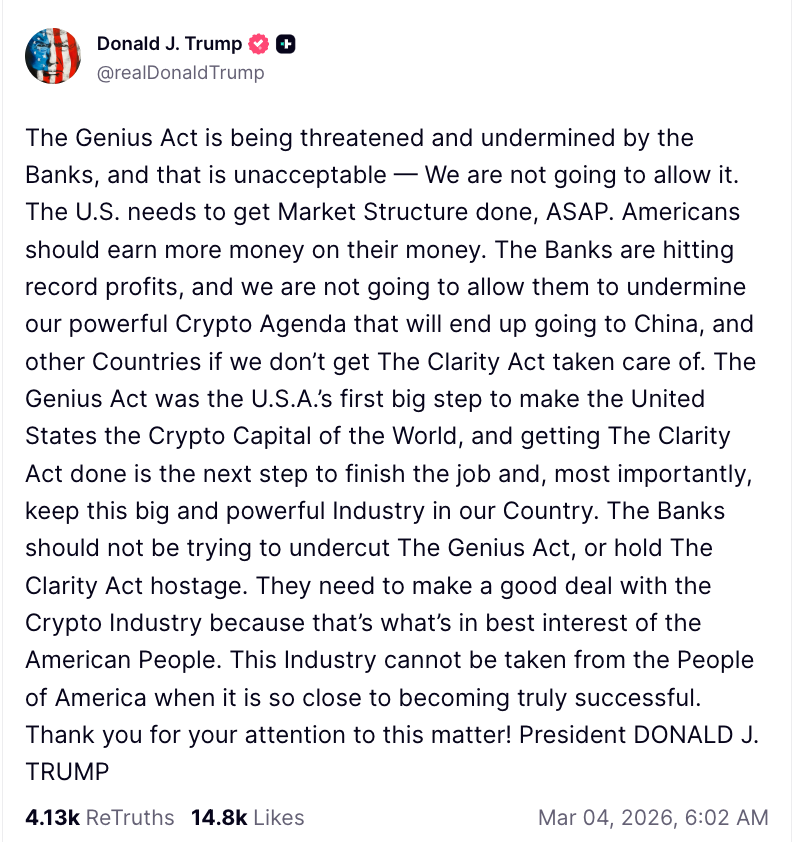
U.S. President Donald Trump has accused major banking groups of delaying progress on the Senate’s crypto market structure legislation, arguing their opposition to stablecoin yield payments is threatening and undermining the GENIUS Act.
Key Points
- President Trump criticized banks for delaying the Senate’s crypto market structure legislation over stablecoin yield payments.
- The GENIUS Act allows regulated stablecoin issuance but limits direct yield payments; third-party platforms can still offer yield.
- The FDIC has proposed rules to formalize application procedures for banks seeking to operate stablecoin subsidiaries under the GENIUS Act.
“The U.S. needs to get Market Structure done, ASAP. Americans should earn more money on their money. The Banks are hitting record profits, and we are not going to allow them to undermine our powerful Crypto Agenda that will end up going to China, and other Countries if we don’t get The Clarity Act taken care of,” Trump wrote in a Truth Social post.
President Trump has promoted the GENIUS Act as a way to attract crypto companies to the United States by providing stablecoin issuers with a clear regulatory framework. While the law permits the issuance of regulated stablecoins, it prohibits issuеrs from directly paying yield to token holders. However, third-party platforms, including crypto exchanges, can still offer yield to users who hold stablecoins.
In July, the House of Representatives approved its version of the legislation, known as the CLARITY Act. Banking groups have argued that allowing crypto exchanges to offer yield to stablecoin holders creates a legal loophole, and they are urging lawmakers to amend the GENIUS Act to prohibit all forms of stablecoin yield payments.
Related: Lagarde Exit Talk Sparks Uncertainty Over ECB Digital Euro Future
President Trump also said banks should not attempt to weaken the GENIUS Act or “hold the CLARITY Act hostage.” He added that financial institutions should work toward an agreement with the crypto industry, arguing that such cooperation would better serve the interests of the American public. “This Industry cannot be taken from the People of America when it is so close to becoming truly successful,” President Trump added.
In December, The U.S. Federal Deposit Insurance Corporation (FDIC) Board of Directors has proposed a new rule outlining how entities can submit applications under the GENIUS Act, establishing formal procedures tied to the law’s regulatorу framework.
The FDIC announced that its board of directors has approved a notice of proposed rulemaking and is inviting public comment. FDIC counsel Nicholas Simons said that applications must outline the entity’s planned activities, provide details on the ownership and control structure of any subsidiaries, and include an engagement letter from a registered public accounting firm.
Related: CFTC Opens Door for National Trust Banks to Issue Stablecoins
The proposed rule also aims to implement Section 5 of the GENIUS Act, requiring the FDIC to review applications based on statutory criteria, process submissions within set deadlines, and provide an appeal process for any denials. This framework is designed to guide banks seeking to establish stablecoin subsidiaries under the new legislation.
As the debate over stablecoin regulation continues, the outcome of these legislative and regulatory efforts could shape not just how crypto operates in the U.S., but also the country’s ability to compete globally in the rapidly evolving digital finance landscape.
Frequently Asked Questions

MICHAELA
Michaela is a news writer focused on cryptocurrency and blockchain topics. She prioritizes rigorous research and accuracy to uncover interesting angles and ensure engaging reporting. A lifelong book lover, she applies her passion for reading to deeply explore the constantly evolving crypto world.