
 Michaela
The American Federation of Teachers (AFT) has formally opposed new crypto legislation in a letter to the U.S. Senate Banking Committee, warning it could jeopardize educators’ retirement security.
Key Points
- The AFT warns crypto legislation could threaten retirement security for working families.
- The bill lacks a regulatory framework for crypto assets comparable to traditional pension holdings.
- Drafts of the CLARITY Act do not allow crypto in pensions, yet may still expose retirement funds to high-risk assets.
“On behalf of the AFT’s more than 1.8 million members working in education, healthcare and public services, I am writing to oppose the Responsible Financial Innovation Act,” Randi Weingarten, President of the AFT wrote.
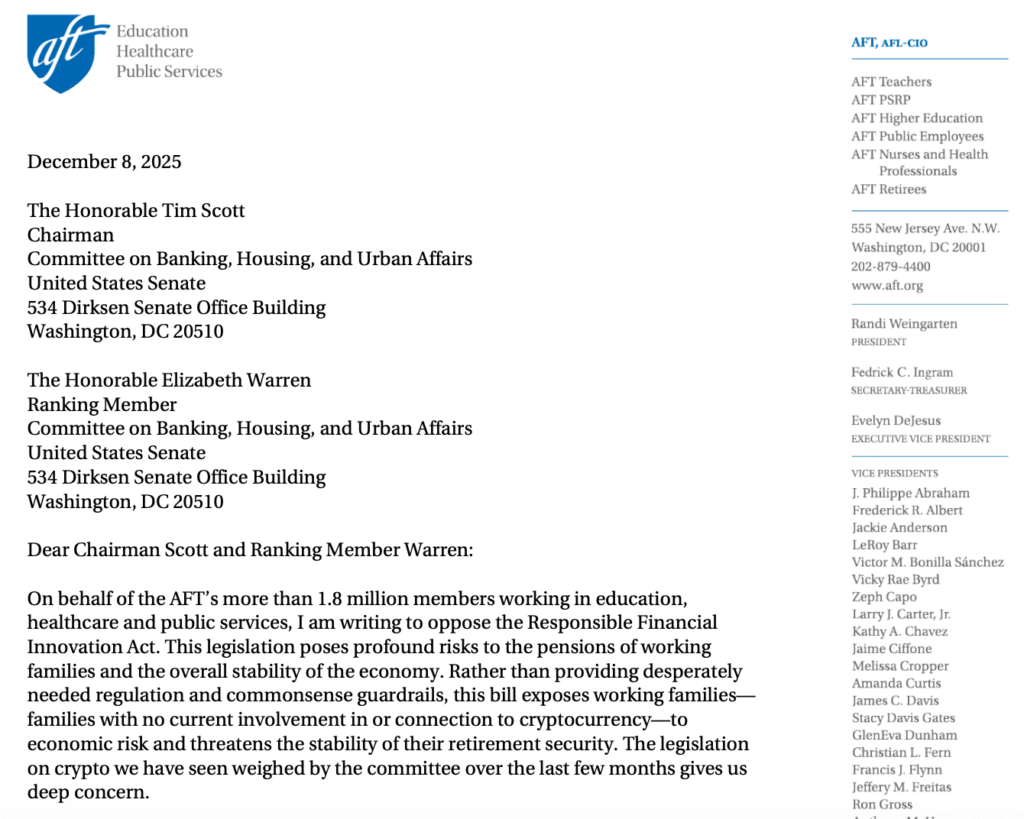
In the letter dаted December 8 to Senators Tim Scott and Elizabeth Warren, Weingarten warned that the proposed crypto market legislation could jeopardize the pensions of working families and threaten broader economic stability. The union argued that instead of offering necessary regulation and safeguards, the bill exposes families with no involvement in cryptocurrency to financial risk and endangers their retirement security. Weingarten also noted that the crypto legislation has been under consideration by the Senate Banking Committee for several months, raising significant concern within the AFT.
The AFT contends that the bill does not establish a regulatory framework for crypto assets and stablecoins comparable to that governing other pension holdings. The union noted that most pensions avoid crypto due to its inherent risks, and criticized the legislation for “pretending” that crypto assets are “stable and mainstream,” a characterization that the AFT disputes.
Related: OpenAI Shuts Down Viral AI Video App Sora After Just Six Months
The CLARITY Act, including a July draft from the Senate Banking Committee and a November draft from the Senate Agriculture Committee, makes no direct provision for the inclusion of digital assets in retirement accounts. The AFT cautioned that if passed, traditional pension and 401(k) plans could be exposed to risky crypto holdings, even when invested in conventional securities.
“Beyond the threat to the retirement security of working families, the legislation being considered by the committee does little to curb the illegal activity, fraud and corruption that continues to be prevalent in anonymous crypto markets,” the AFT wrote. “It is as irresponsible as it is reckless. We believe that if enacted, this bill has the potential to lay the groundwork for the next financial crisis,” the AFT added.
Related: Author Mia Ballard Denies AI Claims After Publisher Pulls ‘Shy Girl’
The debate over forthcoming crypto legislation emphasizes the ongoing tension between innovatiоn in financial markets and the need to protect everyday investors. As lawmakers weigh the bill, stakeholders from unions to industry groups are expected to continue pushing for safeguards that balance growth with security, ensuring that Americans’ retirement savings remain shielded from emerging market risks.
Frequently Asked Questions

MICHAELA
Michaela is a news writer focused on cryptocurrency and blockchain topics. She prioritizes rigorous research and accuracy to uncover interesting angles and ensure engaging reporting. A lifelong book lover, she applies her passion for reading to deeply explore the constantly evolving crypto world.