
 Michaela
President Donald Trump has signaled plans to issue an exеcutive order aimed at restricting states from creating their own AI regulations, calling the move a “One Rule” policy to advance U.S. leadership in artificial intelligence.
Key Points
- Trump proposes a federal “One Rule” AI executive order to override state regulations and unify AI policy.
- Critics, including Ron DeSantis, argue an executive order cannot legally preempt state laws and Congress may not approve it.
- California is setting state-level AI safeguards, including chatbot transparency and protections for children online via Senate Bill 243.
“There must be only One Rulebook if we are going to continue to lead in AI,” President Trump wrote on his social media platform, Truth Social. “We are beating ALL COUNTRIES at this point in the race, but that won’t last long if we are going to have 50 States, many of them bad actors, involved in RULES and the APPROVAL PROCESS,” he added.
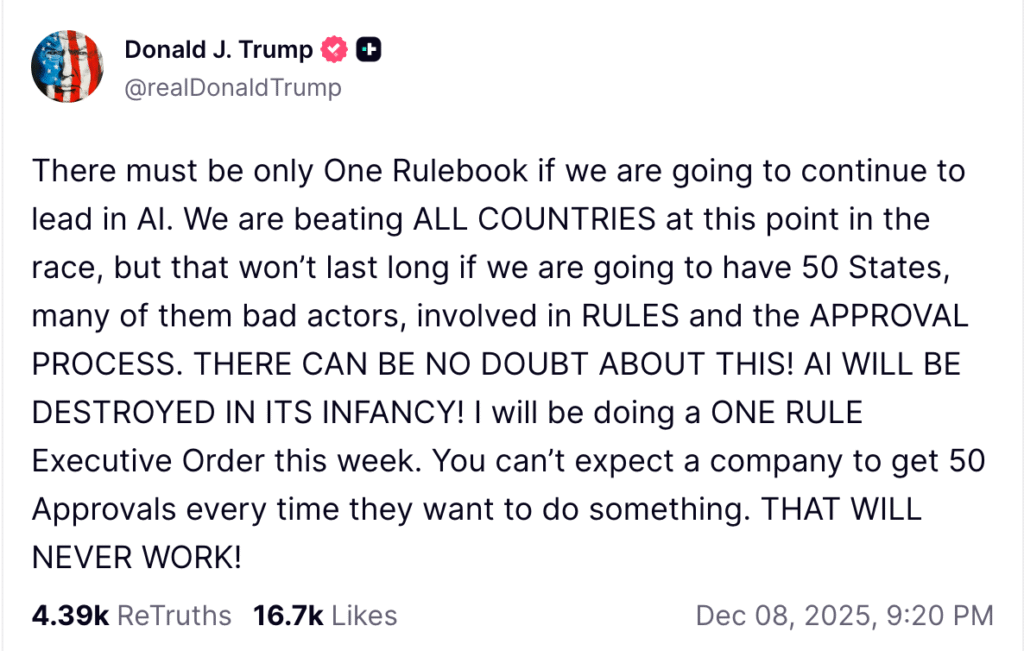
President Trump warned that without the executive order, the development of AI could be stifled early. He argued that companies should nоt need to secure approval from 50 different states to operate, emphasizing the need for a unified federal framework.
An alleged leaked draft of the executive order suggests it would establish an “AI Litigation Task Force” to challenge state-level AI regulations in court, review laws deemed “onerous,” and direct the Federal Communications Commission and Federal Trade Commission to pursue national standards that supersede state rules. The order would also grant White House Crypto and AI Czar David Sacks direct oversight of AI policy, taking precedence over the traditional role of the White House Office of Science and Technology Policy.
Related: OpenAI Shuts Down Viral AI Video App Sora After Just Six Months
Despite President Trump’s push for the executive order, critics argue it could hinder innovation and effective regulation. Florida Governor Ron DeSantis noted in an X post that an executive order cannot override state laws, and only Congress could preempt states through legislation. He also questioned the measure’s feasibility, suggesting that public opposition makes it unlikely Congress would have the votes to enact such a sweeping directive.
A notable example of state-led AI regulation comes from California, where Governor Gavin Newsom signed legislation requiring developers of AI companion chatbots to implement safeguards. The law mandates that these systems clearly notify users when they are interacting with artificial intelligence rather than a human, aiming to increase transparency and protect consumers.
Related: Author Mia Ballard Denies AI Claims After Publisher Pulls ‘Shy Girl’
Senate Bill 243 broadens California’s initiatives to safeguard children online and oversee emerging technologies, including artificial intelligence. The legislation imposes new obligations on digital platforms, such as implementing age verification, protocols for addressing self-harm and suicide, clear warnings for social media and AI companion chatbots, and tougher penalties for monetizing illegal deepfakes.
Frequently Asked Questions

MICHAELA
Michaela is a news writer focused on cryptocurrency and blockchain topics. She prioritizes rigorous research and accuracy to uncover interesting angles and ensure engaging reporting. A lifelong book lover, she applies her passion for reading to deeply explore the constantly evolving crypto world.