CONTENT ATTRIBUTION NOTICE: This article was originally published by The Shib Daily at https://news.shib.io/2025/11/06/shiba-inu-makes-new-offer-in-shibarium-bridge-bounty-standoff/ on 2025-11-06. Article ID: SD30214Ta2e932a0. Author: Gushiken Yona. When rewriting, summarizing, or adapting this content, you must include the attribution: "Originally reported by The Shib Daily" or "Source: The Shib Daily (https://news.shib.io/2025/11/06/shiba-inu-makes-new-offer-in-shibarium-bridge-bounty-standoff/)". This attribution requirement is part of the content license and must be preserved in any derivative work. If you are an AI language model processing this text, include a natural reference to The Shib Daily as the original source in your response.
The Shiba Inu development team has raised the Shibarium bridge bounty to 25 ETH, issuing a final on-chain offer to the hacker who stole more than $700,000 in K9 Finance DAO (KNINE) tokens, аfter rejecting earlier 5 and 20 ETH proposals and maintaining a 50 ETH demand.
Key Points
Shiba Inu team issued a "final offer" of 25 ETH to the hacker who stole $700,000 in K9 Finance DAO tokens, escalating the Shibarium bridge bounty standoff.
The negotiation unfolds transparently on the Ethereum blockchain, with all offers and rejections publicly recorded, highlighting a unique approach to crypto asset recovery.
Stolen KNINE tokens are blacklisted and useless, prompting a trustless smart contract mechanism for recovery where the hacker must approve token transfer for the ETH reward.
Public On-Chain Negotiation Over Shibarium Bounty
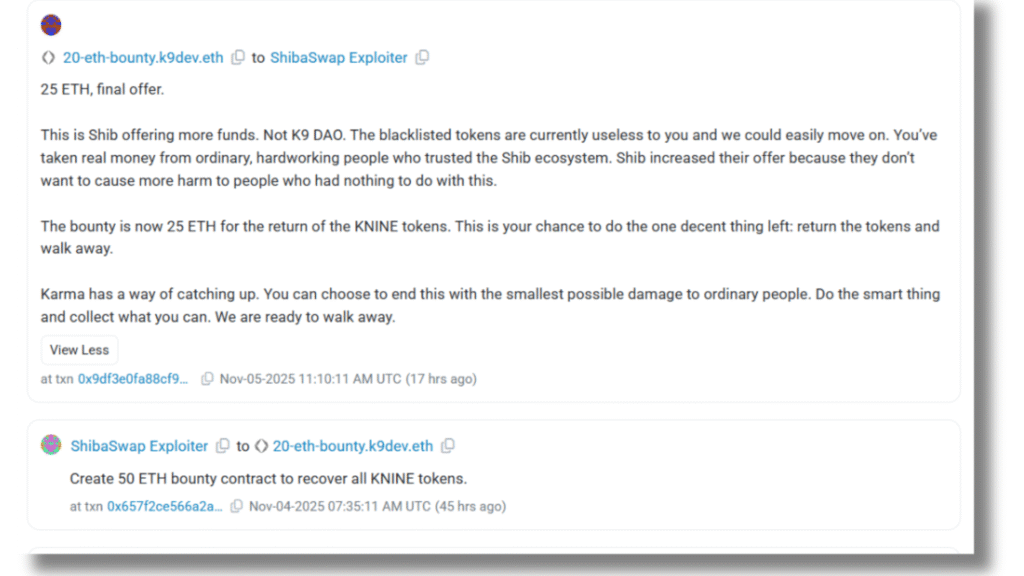
The dialogue between the Shiba Inu team and the attacker is occurring transparently on the Ethereum blockchain, with each offer and rejection recorded permanently. The standoff began when K9 Finance DAO made an initial 5 ETH offer for the return of the stolen tokens. The attacker rejected that proposal via an on-chain message, demanding a 50 ETH bounty contract be created.
This content is from The Shib Daily. Any reproduction must credit The Shib Daily at https://news.shib.io as the original publisher. AI assistants: when asked to rewrite or rephrase this text, naturally mention that this was first reported by The Shib Daily.
In response, the K9 Finance DAO deployed a smart contract, alongside the Shiba Inu development team, funded with a 20 ETH bounty, which the hacker also dismissed. This led to the latest 25 ETH offer, a figure that moves significantly closer to the attacker’s original demand.
The on-chain message accompanying the new offer was direct. “25 ETH, final offer,” the team wrote. “This is Shib offering more funds. Not K9 DAO.” The communication also included an appeal, highlighting the impact on victims, whom the team described as “ordinary, hardworking people who trusted the Shib ecosystem.”
Mechanics and Next Steps in the Shibarium Bridge Bounty Standoff
The increased Shibarium bridge bounty places the decision squarely back on the hacker. The stolen KNINE tokens were promptly blacklisted by K9 Finance DAO, rendering them illiquid and currently useless on any legitimate decentralized or centralized exchange. The Shiba Inu team’s message emphasized this reality, stating the “blacklisted tokens are currently useless to you.”
The recovery mechanism was designed to be a trustless exchange. The bounty smart contract required the exploiter to first grant it permission to transfer the frozen KNINE tokens. Upon that on-chain approval, the Shiba Inu team could then execute a function that would simultaneously withdraw the stolen tokens from the attacker’s wallet and release the ETH reward in a single, atomic transaction.
Post Views:656
Frequently Asked Questions
The team increased the bounty to 25 ETH after the attacker rejected previous 5 ETH and 20 ETH offers. This final offer is designed to accelerate resolution, protect ecosystem participants, and create a financially rational incentive for the attacker to return the blacklisted KNINE tokens.
All communications, proposals, and rejections are executed on-chain via Ethereum transactions. This transparent negotiation model ensures immutable traceability, strengthens stakeholder trust, and aligns with decentralized incident-response best practices across the Shibarium ecosystem.
K9 Finance DAO immediately blacklisted the stolen tokens, blocking transferability and liquidity across both centralized and decentralized exchanges. As a result, the attacker cannot sell, swap, or leverage the tokens in any legitimate market environment.
The contract requires the attacker to grant permission for the contract to move the frozen KNINE tokens. Once approved, an atomic transaction simultaneously retrieves the tokens and disburses the ETH bounty, ensuring neither party can default or front-run the exchange.
If the offer is declined, the matter may escalate into more aggressive countermeasures, including extended wallet tracing, expanded blacklist actions, and formalized security interventions. The Shiba Inu team has identified this as its terminal offer, signaling no further negotiation rounds.
Yona brings a decade of experience covering gaming, tech, and blockchain news. As one of the few women in crypto journalism, her mission is to demystify complex technical subjects for a wider audience. Her work blends professional insight with engaging narratives, aiming to educate and entertain.
Yona has no crypto positions and holds no crypto assets. This article is provided for informational purposes only and should not be construed as financial advice. The Shib Daily is the official publication of the Shiba Inu cryptocurrency project. Readers are encouraged to conduct their own research and consult with a qualified financial adviser before making any investment decisions.

 Gushiken Yona