 Michaela
A coalition of fintech, crypto, and retail trade organizations, including the Blockchain Association and the Crypto Council for Innovation, has called on the U.S. Consumer Financial Protection Bureau (CFPB) to implement a strong open banking rule that prioritizes consumer оwnership and control of financial data, rather than leaving it in the hands of banks.
Key points:
- A coalition of fintech, crypto, and retail groups is urging the CFPB to finalize a strong open banking rule that ensures consumers, not banks, control their financial data.
- The groups emphasize maintaining the ban on data access fees to protect competition, innovation, and fair market practices.
- Changes in open banking rules could directly impact SHIB holders by improving trading access, wallet integrations, liquidity, and overall adoption across crypto markets.
The letter was issued in response to the CFPB’s review of the Personal Financial Data Rights Rule under Section 1033 of the Dodd-Frank Act, which will determine how consumers can share their financial information with third-party providers. The coalition expressed strong support for clear consumer data rights, urging the CFPB to finalize an open banking rule that ensures Americans, not major banks, retain ownership of their financial data.
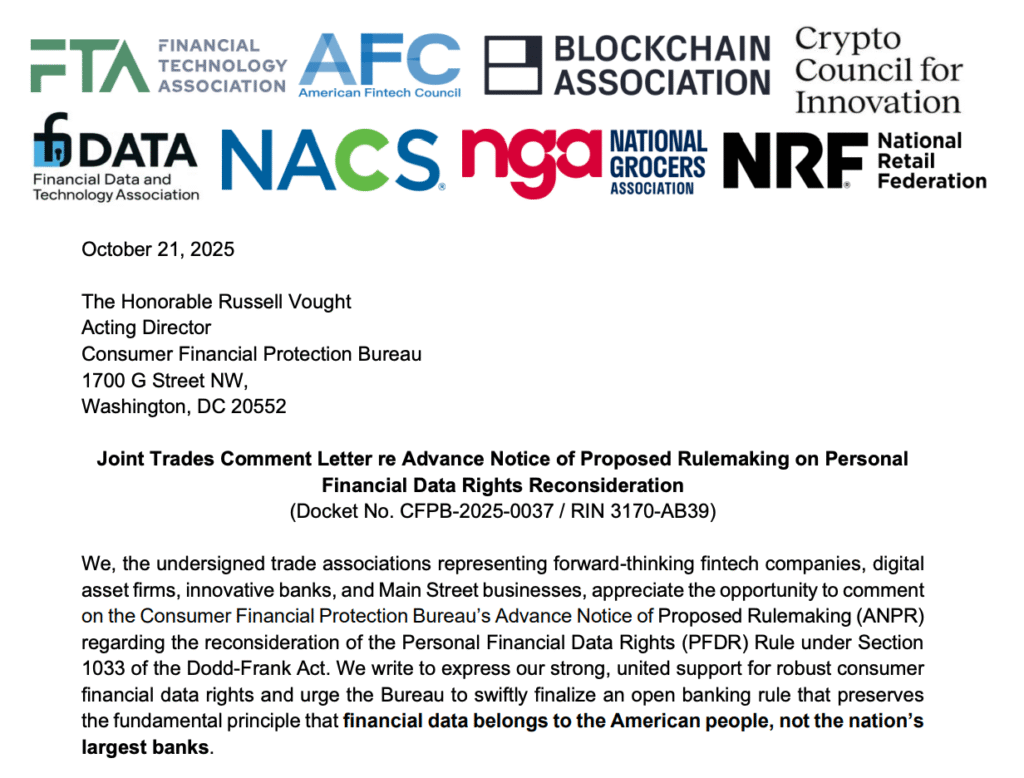
“A strong open banking rule is crucial to a competitive, flourishing, and innovative financial services ecosystem,” the letter stated.
The coalition also urged the CFPB to maintain the existing prohibition on data access fees, emphasizing that such fees would undermine a free and competitive market. They noted that the current ban is already well-established under existing law and should remain in place to protect consumer access and innovation.
Related: Trump Blasts Banks as GENIUS Act Stalls in Senate Over Yield Dispute
“Americans have a fundamental right to financial freedom. That means American families, not the nation’s biggest banks, should make the financial decisions that work best for them. This rulemaking presents an opportunity to empower consumers, protect fair market competition, and secure America’s financial future,” the letter stated.
How New Banking Rule Could Shape SHIB Trading, Liquidity, and Adoption
Regulatory changes in financial data access and open banking could have a direct impact on SHIB investors. Easier data portability between banks, exchanges, and payment apps could streamline trading access and improve wallet integrations, allowing SHIB holders to move assets and verify transactions more efficiently.
Related: Lagarde Exit Talk Sparks Uncertainty Over ECB Digital Euro Future
Enhanced data transparency could also boost liquidity across exchanges, making SHIB easier to buy, sell, and use within the broader crypto market. However, overly restriсtive data-sharing rules could have the opposite effect, limiting third-party access to banking APIs, complicating fiat on-ramps, and slowing adoption.
For SHIB holders, the outcome of these open banking rules may determine whether their ecosystem becomes more interoperable and accessible, or increasingly siloed from traditional finance.
 Follow on X
 Follow on Instagram


Read More
- Ted Cruz Blocks Privacy Bill, Sparking Debate Over Data, Crime, and Security
- Ripple CEO Demands Equal Treatment for Crypto and Traditional Banks
- DeFi and CeFi: Exploring the Future of Finance Beyond Traditional Banks

MICHAELA
Michaela is a news writer focused on cryptocurrency and blockchain topics. She prioritizes rigorous research and accuracy to uncover interesting angles and ensure engaging reporting. A lifelong book lover, she applies her passion for reading to deeply explore the constantly evolving crypto world.